
- News
- City News
- lucknow News
- Forgotten sister of taj lies in a shambles
Trending
This story is from June 18, 2023
Forgotten sister of taj lies in a shambles
Imagine two monuments 170km apart, separated from each other by a mere four-hour drive! Both are the resting place of two sisters but one of these is a major attraction frequented by people from all over the world while the access route to the other passes through a dump yard. Perhaps, there is no greater contrast between two siblings in the world than this, definitely not in India.
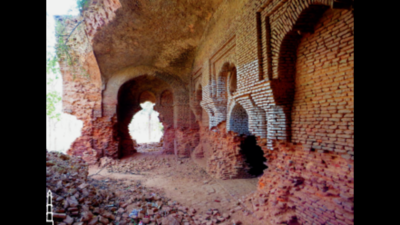
Though looking at an old ‘haveli’ in Sheikhupur, one gets the sense that when the storm comes, it is easier for a poor, obscure Nawab to ride it out than for an Empero
Journey to the tomb
To experience this contrast, one must visit Sheikhupur village, 5km from Badaun district, which itself is 250km from the state capital.

The focal point is a large tomb made of red stone, standing on a high platform,its sides punctuated with arched entrances. After visitors pass through the arches into a corridor which runs all around a central chamber, they find several graves built on and around a platform in the middle.
Koka’s imperial connection
According to historians, Qutubuddin Koka was the foster brother of Mughal emperor Jahangir. He is said to have been the emperor’s secretary and later the governor of the rich province of Bengal as well which shows that he held a considerable clout in the royal court.
Beyond his own status, Koka also came from an illustrious family. He was the grandson of Sheikh Salim Chisti, the Sufi saint held in great regard by Akbar and whose tomb was built inside the emperor’s fort in Fatehpur Sikri.
A daughter of Salim Chisti was foster mother to Jahangir, and as a result, the two boys may have been close. It is sometimes said that the place called Sheikhupur was named in remembrance of the boyhood name of Jahangir, ‘Sheikhu’.
Parwar Khanum & her family
The story of the Badaun monument is of Qutabuddin Koka’s daughter-in-law, Parwar Khanum. Parwar was the daughter of Abul Hasan (also known by his title ‘Asaf Khan’), a powerful Mughal nobleman. The daughter of Hasan marrying the son of Koka was a match between two influential families of Mughal nobility.
There was an even more illustrious match among Parwar’s siblings. Her sister, Arjumand Bano Begum, was married to Jahangir’s son Prince Khurram. Khurram’s ascending the throne as Shah Jahan would have been Abul Hasan’s moment of glory.
Among the children born of this marriage was the future emperor Aurangzeb, which essentially meant that all emperors beyond this were also descendants of Asaf Khan. By extension, Aurangzeb was the nephew of Parwar Khanum.
Comparing the two sisters & their resting places
The way things panned out, Parwar Khanum was married in a powerful noble family, almost equal in status to the one she was born into. Her sister, however, went one better – marrying a future emperor was definitely better than a nobleman.
Hence, while Parwar Khanum was eventually confined to a tomb in the tiny Sheikhupur village in Badaun, her sister Arjumand Bano Begum was titled ‘Mumtaz Mahal’ and when she died, Shah Jahan built the Taj Mahal as her resting place. While the Taj is still India’s most visited monument, and is a UNESCO World Heritage site, Parwar Khanum’s tomb is nearing collapse.
While one sister’s descendants were Mughal emperors, those of the other gradually sank into a quiet life at Sheikhupur. The hand of time is fairly democratic.
Eventually, the emperors too have vanished and Mumtaz Mahal’s descendants are probably in no better state today than those of her sister. Though looking at an old ‘haveli’ in Sheikhupur, one gets the sense that when the storm comes, it is easier for a poor, obscure Nawab to ride it out than for an Emperor.
End of Article
FOLLOW US ON SOCIAL MEDIA






Photostories

Hot Picks
TOP TRENDING
Popular Categories
Hot on the Web
Top Trends
AUS vs SA Live ScoreRohit SharmaLiam PayneUGC Net June ResultSL vs WI Live ScoreIND vs NZ HighlightsUGC NET ResultInfosys Q2 ResultHaryana Cabinet Ministers ListJustin TrudeauFlights Bomb ThreatJharkhand Election ScheduleMaharashtra Election 2024US Presidential Election 2024Maharashtra Election ScheduleJharkhand Election ScheduleLive Cricket Score
Trending Topics
Diwali WishesDhanteras 2024Fake PaneerLiam PayneVettaiyan CollectionVicky Vidya Ka Woh Wala Video CollectionLawrence BishnoiJigra OTT ReleaseCow GheeBigg Boss 18Salman KhanShraddha KapoorRenukaswamys WifeSharad Purnima Moonrise TimeSwatantrya Veer SavarkarSharad Purnima 2024Top Load Washing MachinesBest Premium LaptopsIntel LayoffsWordle Answer
Living and entertainment
Latest News
Drake's pigtails spark an online debate; netizens are divided over bold fashion move and midlife crisisInjury scare for Team India as Rishabh Pant hobbles off the fieldHappy Dhanteras 2023: Images, Quotes, Wishes, Messages, Cards, Greetings, Pictures and GIFsBigg Boss Tamil 8 Preview: Emotional turmoil as housemates tease Dharsha Gupta over her cookingCitizenship under Assam accord: 4:1 SC verdict upholds validity of Section 6A; dissenting judge says provision 'has become more prone to abuse'Kartik Maas 2024 Start and End Date: Time, Puja Rituals and SignificanceStudent kills self in Kota, 15th this yr'Love Rohit Sharma's honesty': Sanjay Manjrekar calls India captain 'top man''Secret service needs reform': Independent probe panel on Trump's assassinationBreast cancer fighter Hina Khan shares a video of people who have inspired her during her journey; watchWWE Superstar Seth Rollins confirms date and occasion for in-ring returnAt 25,007 weekly departures, 5% more domestic flights this winter: DGCAUGC NET Result 2024 OUT: Direct link to check subject/category wise cut-offSolo, but never alone! Embrace Abu Dhabi’s unique experiences for independent adventurersKaveri Theerthodbhava 2024: A spiritual gathering at TalakaveriWatch: Rohit Sharma's reaction as KL Rahul drops a sitter against New ZealandWomen with Higher Education Are Less Likely to Quit Jobs After Marriage: A Look at India’s Gender Divide in Education and the WorkforceIn a breakthrough, Indian scientists develop unique method to treat brain tuberculosis
Copyright © 2024 Bennett, Coleman & Co. Ltd. All rights reserved. For reprint rights: Times Syndication Service